


Unified Magazine provides expert insights on business, technology, and innovation. We partner with leading entrepreneurs to provide strategic advice and market analysis, empowering professionals and entrepreneurs with resources for success and growth.
Subscribe to Updates
Get the latest creative news from FooBar about art, design and business.

Setu Joshi: Reinventing Automotive Experiences hrough Intelligent Technology
Chief Information Officer – Mercedes-Benz Mexico
Voices For Children Foundation is committed to creating lasting impact for foster youth by providing critical resources, emotional support, mentorship, and pathways to self-sufficiency. Kadie Black’s vision is to build a more compassionate and collaborative child welfare system where every child is seen, supported, and empowered to thrive beyond foster care.
Setu Joshi's Exclusive
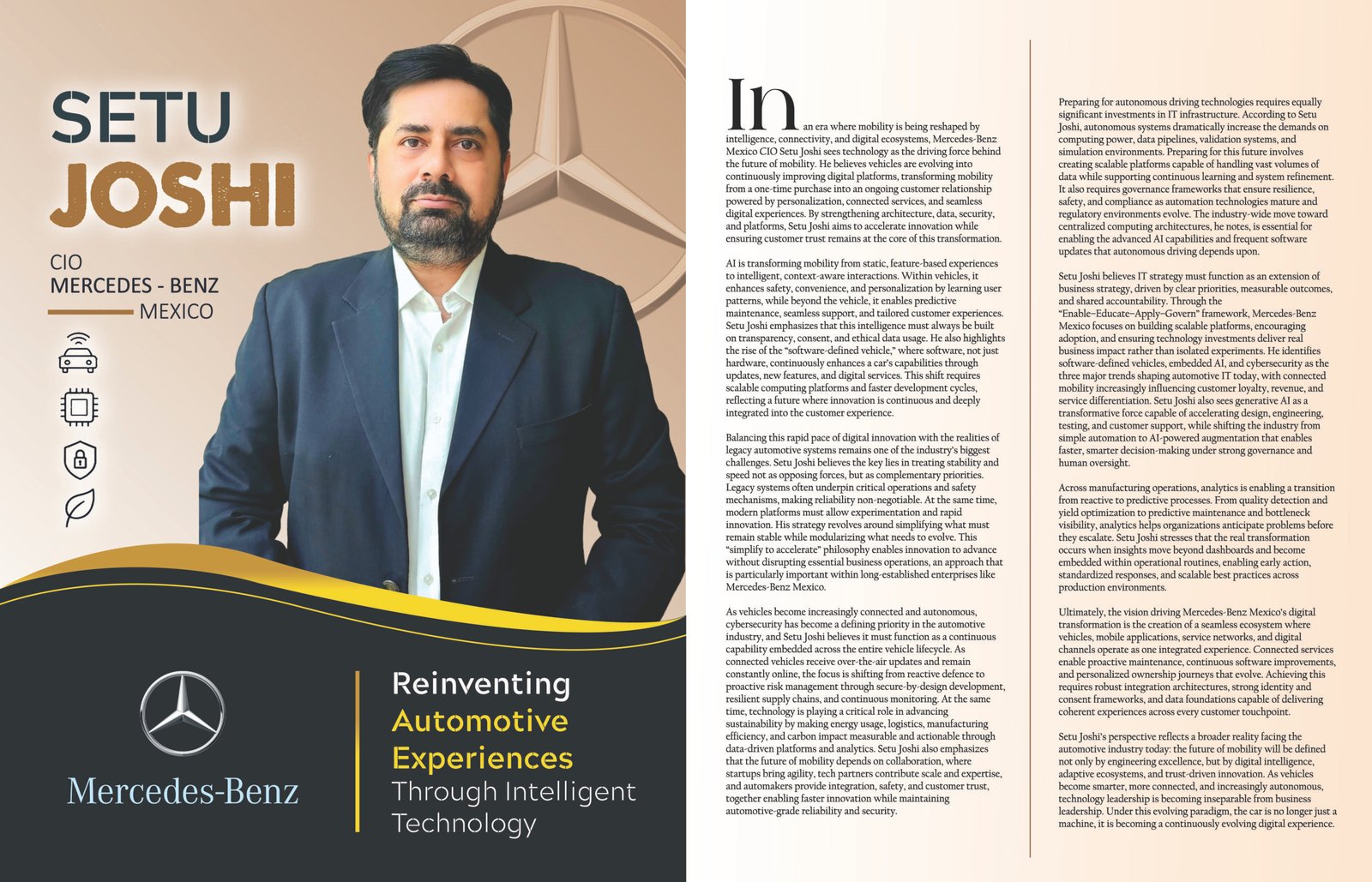
In an era where mobility is being reshaped by intelligence, connectivity, and digital ecosystems, Mercedes-Benz Mexico CIO Setu Joshi sees technology as the driving force behind the future of mobility. He believes vehicles are evolving into continuously improving digital platforms, transforming mobility from a one-time purchase into an ongoing customer relationship powered by personalization, connected services, and seamless digital experiences. By strengthening architecture, data, security, and platforms, Setu Joshi aims to accelerate innovation while ensuring customer trust remains at the core of this transformation.
AI is transforming mobility from static, feature-based experiences to intelligent, context-aware interactions. Within vehicles, it enhances safety, convenience, and personalization by learning user patterns, while beyond the vehicle, it enables predictive maintenance, seamless support, and tailored customer experiences. Setu Joshi emphasizes that this intelligence must always be built on transparency, consent, and ethical data usage. He also highlights the rise of the “software-defined vehicle,” where software, not just hardware, continuously enhances a car’s capabilities through updates, new features, and digital services. This shift requires scalable computing platforms and faster development cycles, reflecting a future where innovation is continuous and deeply integrated into the customer experience.
Balancing this rapid pace of digital innovation with the realities of legacy automotive systems remains one of the industry’s biggest challenges. Setu Joshi believes the key lies in treating stability and speed not as opposing forces, but as complementary priorities. Legacy systems often underpin critical operations and safety mechanisms, making reliability non-negotiable. At the same time, modern platforms must allow experimentation and rapid innovation. His strategy revolves around simplifying what must remain stable while modularizing what needs to evolve. This “simplify to accelerate” philosophy enables innovation to advance without disrupting essential business operations, an approach that is particularly important within long-established enterprises like Mercedes-Benz.
As vehicles become increasingly connected and autonomous, cybersecurity has become a defining priority in the automotive industry, and Setu Joshi believes it must function as a continuous capability embedded across the entire vehicle lifecycle. As connected vehicles receive over-the-air updates and remain constantly online, the focus is shifting from reactive defence to proactive risk management through secure-by-design development, resilient supply chains, and continuous monitoring. At the same time, technology is playing a critical role in advancing sustainability by making energy usage, logistics, manufacturing efficiency, and carbon impact measurable and actionable through data-driven platforms and analytics. Setu Joshi also emphasizes that the future of mobility depends on collaboration, where startups bring agility, tech partners contribute scale and expertise, and automakers provide integration, safety, and customer trust, together enabling faster innovation while maintaining automotive-grade reliability and security.
Preparing for autonomous driving technologies requires equally significant investments in IT infrastructure. According to Setu Joshi, autonomous systems dramatically increase the demands on computing power, data pipelines, validation systems, and simulation environments. Preparing for this future involves creating scalable platforms capable of handling vast volumes of data while supporting continuous learning and system refinement. It also requires governance frameworks that ensure resilience, safety, and compliance as automation technologies mature and regulatory environments evolve. The industry-wide move toward centralized computing architectures, he notes, is essential for enabling the advanced AI capabilities and frequent software updates that autonomous driving depends upon.
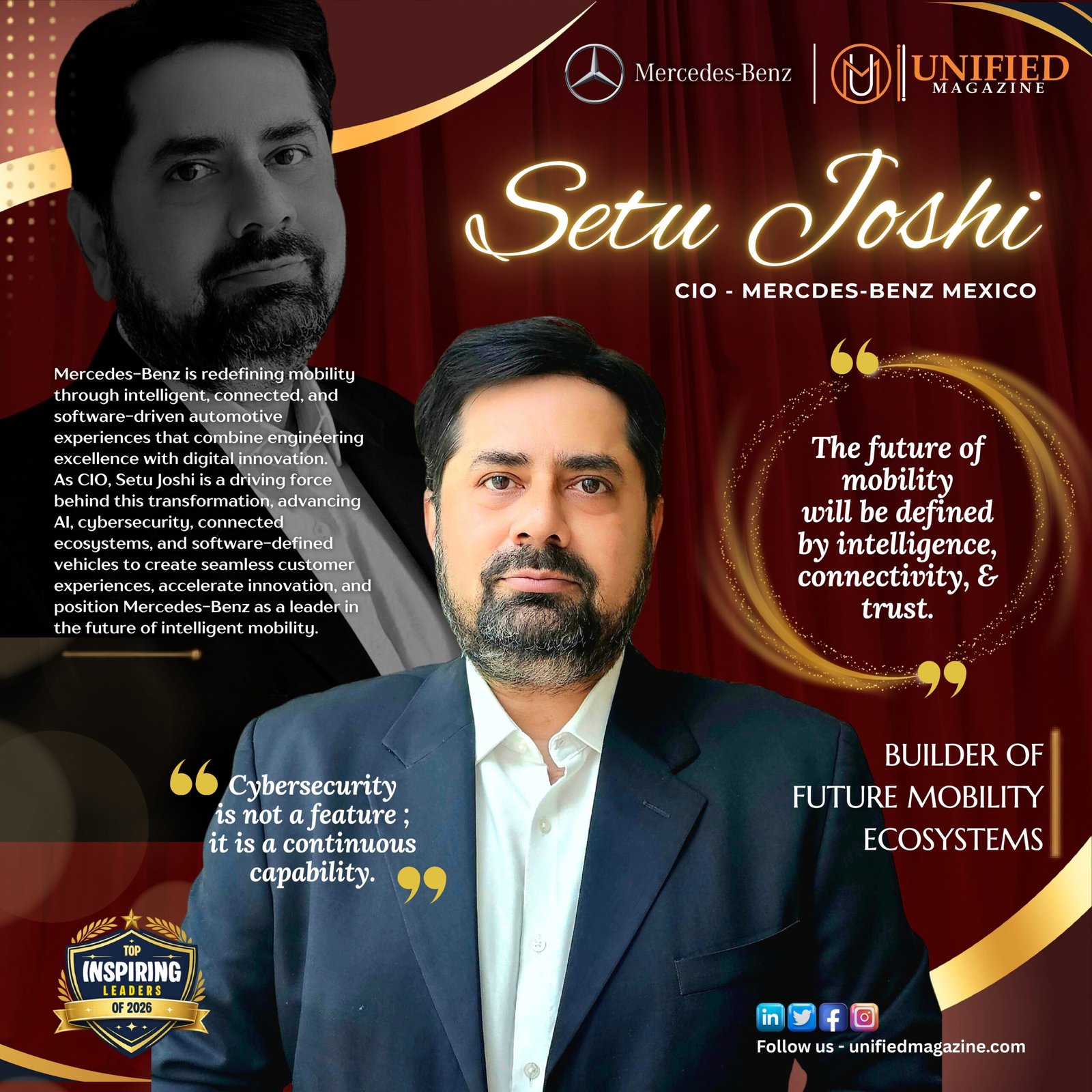
“The future of mobility will be defined by intelligence, connectivity, and trust.”
Setu Joshi believes IT strategy must function as an extension of business strategy, driven by clear priorities, measurable outcomes, and shared accountability. Through the “Enable–Educate–Apply–Govern” framework, Mercedes-Benz focuses on building scalable platforms, encouraging adoption, and ensuring technology investments deliver real business impact rather than isolated experiments. He identifies software-defined vehicles, embedded AI, and cybersecurity as the three major trends shaping automotive IT today, with connected mobility increasingly influencing customer loyalty, revenue, and service differentiation. Setu Joshi also sees generative AI as a transformative force capable of accelerating design, engineering, testing, and customer support, while shifting the industry from simple automation to AI-powered augmentation that enables faster, smarter decision-making under strong governance and human oversight.
Across manufacturing operations, analytics is enabling a transition from reactive to predictive processes. From quality detection and yield optimization to predictive maintenance and bottleneck visibility, analytics helps organizations anticipate problems before they escalate. Setu Joshi stresses that the real transformation occurs when insights move beyond dashboards and become embedded within operational routines, enabling early action, standardized responses, and scalable best practices across production environments.
Ultimately, the vision driving Mercedes-Benz Mexico’s digital transformation is the creation of a seamless ecosystem where vehicles, mobile applications, service networks, and digital channels operate as one integrated experience. Connected services enable proactive maintenance, continuous software improvements, and personalized ownership journeys that evolve. Achieving this requires robust integration architectures, strong identity and consent frameworks, and data foundations capable of delivering coherent experiences across every customer touchpoint.
Setu Joshi’s perspective reflects a broader reality facing the automotive industry today: the future of mobility will be defined not only by engineering excellence, but by digital intelligence, adaptive ecosystems, and trust-driven innovation. As vehicles become smarter, more connected, and increasingly autonomous, technology leadership is becoming inseparable from business leadership. Under this evolving paradigm, the car is no longer just a machine, it is becoming a continuously evolving digital experience.


Copyrights ©2026 Unified Magazine. All rights reserved