


Unified Magazine provides expert insights on business, technology, and innovation. We partner with leading entrepreneurs to provide strategic advice and market analysis, empowering professionals and entrepreneurs with resources for success and growth.
Subscribe to Updates
Get the latest creative news from FooBar about art, design and business.

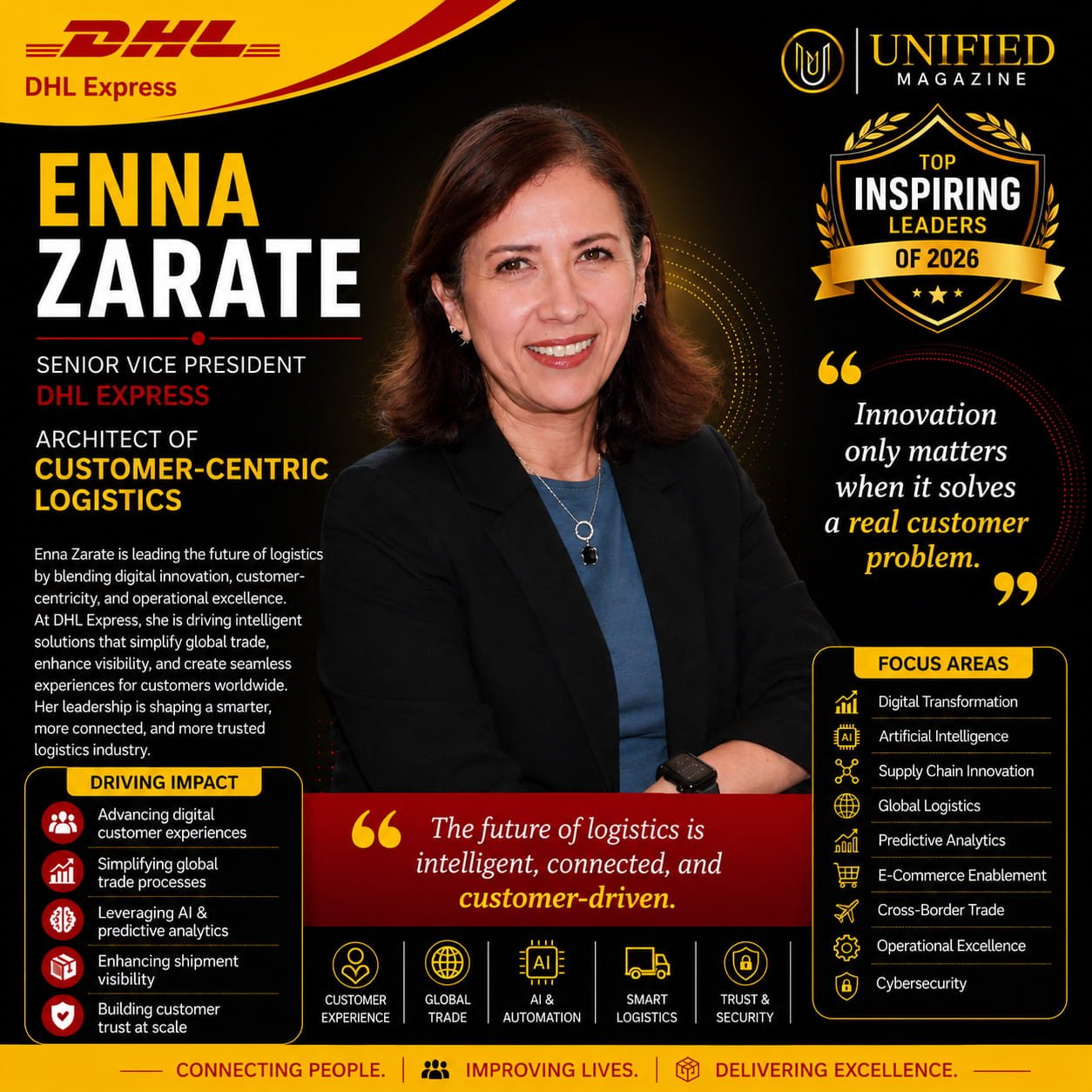
Enna Zarate: Building Smarter Logistics with Customer-Centric Innovation
Senior Vice President of DHL Express
DHL is the leading global brand in the logistics industry. Our divisions offer an unrivaled portfolio of logistics services ranging from national and international parcel delivery, e-commerce shipping and fulfillment solutions, international express, road, air and ocean transport to industrial supply chain management.
With specialized solutions for growth markets and industries including technology, life sciences and healthcare, engineering, manufacturing & energy, auto-mobility and retail, DHL is decisively positioned as “The logistics company for the world”.
Enna Zarate's Exclusive
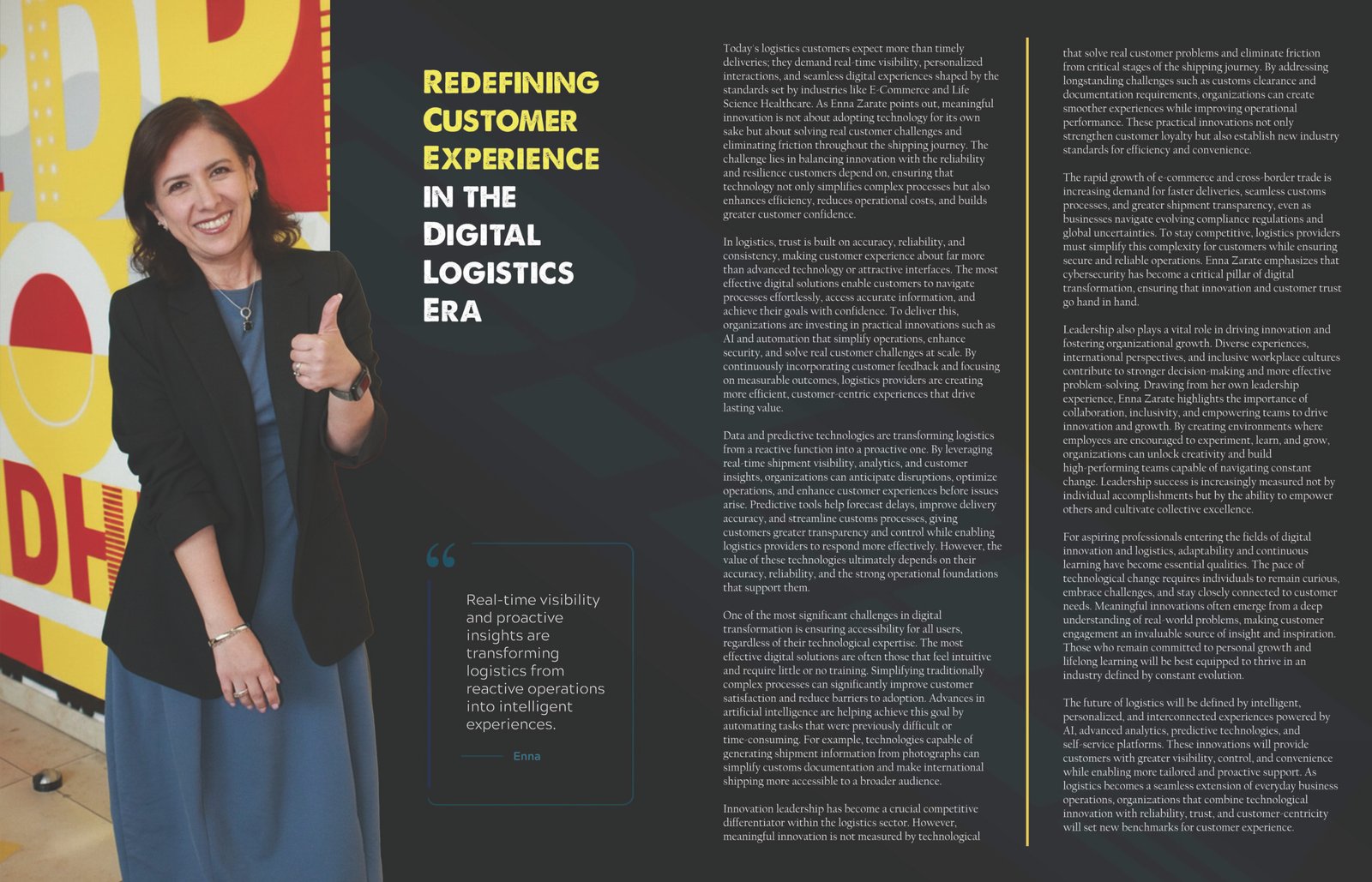
According to Enna Zarate, the logistics industry is undergoing a profound transformation, driven by rapid technological advancements, changing customer expectations, and the growing complexity of global trade. A renewed focus on digital customer experiences is reshaping the industry, making speed, transparency, reliability, and personalization essential rather than optional. As organizations adapt to this changing landscape, digital innovation is becoming a defining factor in shaping how businesses connect with customers and deliver value across global supply chains.
Today’s logistics customers expect more than timely deliveries; they demand real-time visibility, personalized interactions, and seamless digital experiences shaped by the standards set by industries like E-Commerce and Life Science Healthcare. As Enna Zarate points out, meaningful innovation is not about adopting technology for its own sake but about solving real customer challenges and eliminating friction throughout the shipping journey. The challenge lies in balancing innovation with the reliability and resilience customers depend on, ensuring that technology not only simplifies complex processes but also enhances efficiency, reduces operational costs, and builds greater customer confidence.
In logistics, trust is built on accuracy, reliability, and consistency, making customer experience about far more than advanced technology or attractive interfaces. The most effective digital solutions enable customers to navigate processes effortlessly, access accurate information, and achieve their goals with confidence. To deliver this, organizations are investing in practical innovations such as AI and automation that simplify operations, enhance security, and solve real customer challenges at scale. By continuously incorporating customer feedback and focusing on measurable outcomes, logistics providers are creating more efficient, customer-centric experiences that drive lasting value.
Data and predictive technologies are transforming logistics from a reactive function into a proactive one. By leveraging real-time shipment visibility, analytics, and customer insights, organizations can anticipate disruptions, optimize operations, and enhance customer experiences before issues arise. Predictive tools help forecast delays, improve delivery accuracy, and streamline customs processes, giving customers greater transparency and control while enabling logistics providers to respond more effectively. However, the value of these technologies ultimately depends on their accuracy, reliability, and the strong operational foundations that support them.
One of the most significant challenges in digital transformation is ensuring accessibility for all users, regardless of their technological expertise. The most effective digital solutions are often those that feel intuitive and require little or no training. Simplifying traditionally complex processes can significantly improve customer satisfaction and reduce barriers to adoption. Advances in artificial intelligence are helping achieve this goal by automating tasks that were previously difficult or time-consuming. For example, technologies capable of generating shipment information from photographs can simplify customs documentation and make international shipping more accessible to a broader audience.
Innovation leadership has become a crucial competitive differentiator within the logistics sector. However, meaningful innovation is not measured by technological novelty alone. The most impactful advancements are those that solve real customer problems and eliminate friction from critical stages of the shipping journey. By addressing longstanding challenges such as customs clearance and documentation requirements, organizations can create smoother experiences while improving operational performance. These practical innovations not only strengthen customer loyalty but also establish new industry standards for efficiency and convenience.
The rapid growth of e-commerce and cross-border trade is increasing demand for faster deliveries, seamless customs processes, and greater shipment transparency, even as businesses navigate evolving compliance regulations and global uncertainties. To stay competitive, logistics providers must simplify this complexity for customers while ensuring secure and reliable operations. Enna Zarate emphasizes that cybersecurity has become a critical pillar of digital transformation, ensuring that innovation and customer trust go hand in hand.
Leadership also plays a vital role in driving innovation and fostering organizational growth. Diverse experiences, international perspectives, and inclusive workplace cultures contribute to stronger decision-making and more effective problem-solving. Drawing from her own leadership experience, Enna Zarate highlights the importance of collaboration, inclusivity, and empowering teams to drive innovation and growth. By creating environments where employees are encouraged to experiment, learn, and grow, organizations can unlock creativity and build high-performing teams capable of navigating constant change. Leadership success is increasingly measured not by individual accomplishments but by the ability to empower others and cultivate collective excellence.
For aspiring professionals entering the fields of digital innovation and logistics, adaptability and continuous learning have become essential qualities. The pace of technological change requires individuals to remain curious, embrace challenges, and stay closely connected to customer needs. Meaningful innovations often emerge from a deep understanding of real-world problems, making customer engagement an invaluable source of insight and inspiration. Those who remain committed to personal growth and lifelong learning will be best equipped to thrive in an industry defined by constant evolution.
The future of logistics will be defined by intelligent, personalized, and interconnected experiences powered by AI, advanced analytics, predictive technologies, and self-service platforms. These innovations will provide customers with greater visibility, control, and convenience while enabling more tailored and proactive support. As logistics becomes a seamless extension of everyday business operations, organizations that combine technological innovation with reliability, trust, and customer-centricity will set new benchmarks for customer experience.



Copyrights ©2026 Unified Magazine. All rights reserved