John M. Dobrowolski - Shaping the future of rental intelligence through 50 years of innovation, growth, and teamwork

    Founder & CEO of Rent Bureau of Canada®

    What began in 1976 as one landlord solving a tenant problem grew into Rentcheck®, Canada’s leading rental history database. For 50 years, the company has united housing providers to share data responsibly, transforming tenant screening while ensuring fairness, transparency, and recognition for responsible renters nationwide.

    John Dobrowolski's Excellence

    This year, Rentcheck®, a 100% Canadian owned and operated leader in applicant screening services, celebrates half a century of serving the rental housing industry—and beyond.

    The inspiring story of how the company evolved, and continues to innovate, is about the founding CEO’s shared vision, which galvanized a national network of housing providers and professionals across other industries, to help build a powerful, secure and efficient data resource.

    From humble beginnings among a few landlords needing better decision-making tools, Rentcheck® has gone from strength to strength, thanks to the power of member-shared information and collaborative leadership. This is how one of Canada’s unique business success stories came to be.

    From a Grassroots Network to Leading-edge Technology – How John M. Dobrowolski and Rent Bureau of Canada® Transformed Tenant Screening and Housing Transparency

    For decades, the rental housing industry has struggled with the challenge of accurately assessing the reliability of potential tenants while ensuring fairness, equal opportunity and transparency for all housing applicants.

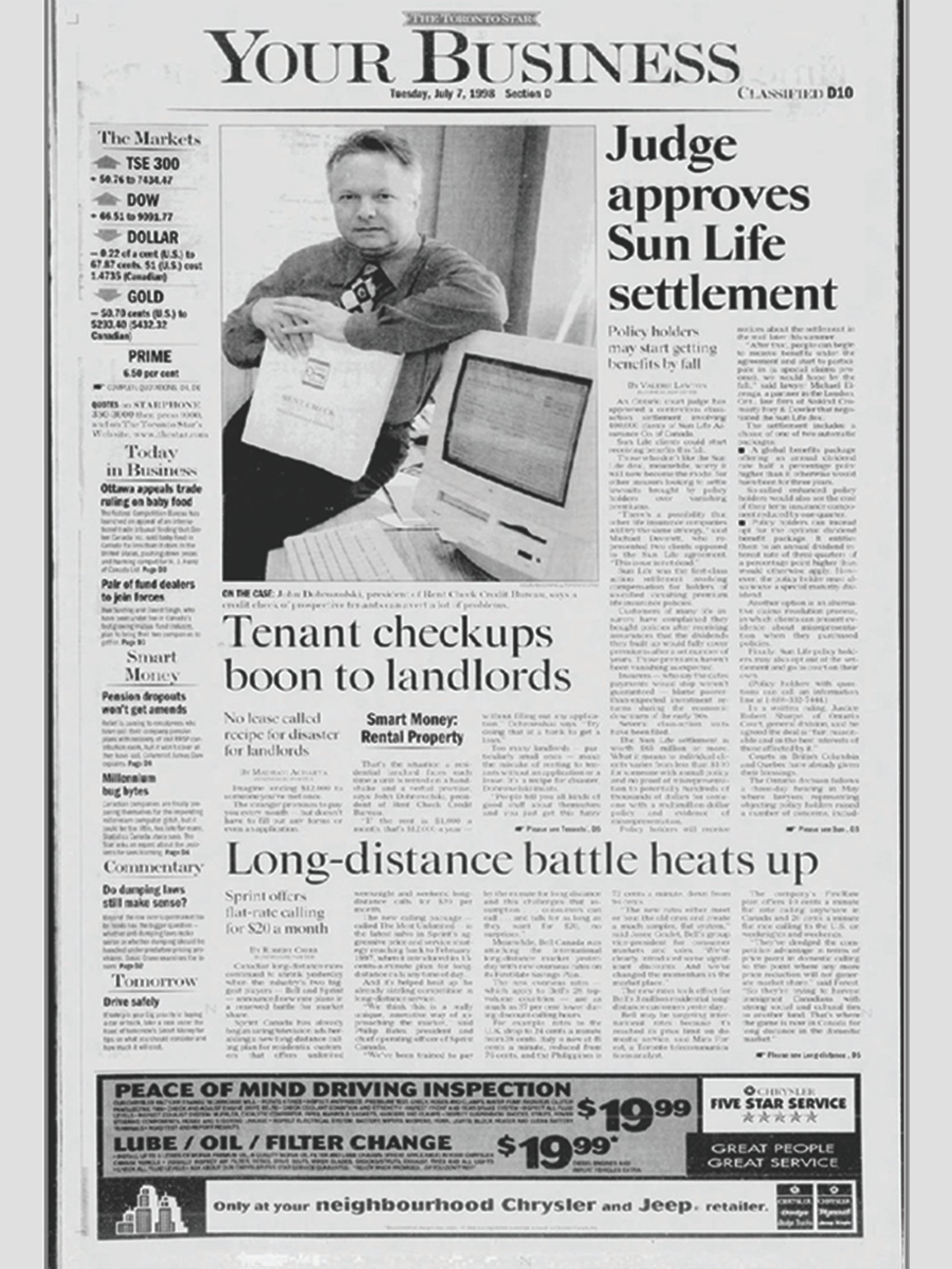
    Fifty years ago, and twenty years before widespread public access to consumer credit records, Canadian rental property entrepreneur John M.Dobrowolski recognised significant issues in how tenancy decisions were made and how they were managed when problems arose. 

    Back then, many leases were settled on unverified anecdotal references and a handshake. When a tenant refused to pay housing costs or damaged the premises, landlords, especially small entrepreneurs, had little recourse for recovering their losses.  

    What began in the mid-1970s as Dobrowolski’s straightforward attempt to resolve his own problems by sharing tenant concerns with fellow landlords grew into a collaborative network of like-minded people that evolved into one of Canada and North America’s largest and most influential rental history databases.

    What began in 1976 as the Canadian Tenant Network evolved into the Rent Bureau of Canada®, doing business as Rentcheck® Ltd., a federally-accredited credit bureau licensed to operate in more than half of Canada’s provinces and territories and recognized by seven international cybersecurity agencies.  

    Today, Rent Bureau of Canada® / Rentcheck® manages hundreds of millions of months of privacy-compliant, member-shared rental history data, which enables the company to provide advanced screening tools to housing providers nationwide.

    Thanks to the continued engagement of member housing providers from coast-to-coast, Rentcheck® has not only transformed how landlords assess applicants, but has also helped numerous responsible tenants receive overdue recognition for maintaining positive rental payment histories.

    A single idea, born from a difficult tenant experience, developed into a grassroots housing provider network that gave birth to a national housing intelligence platform. To this day, Rentcheck® exists because thousands of people believe in John M. Dobrowolski’s vision of a rental housing industry dedicated to the common good of all.

    The Origins: A 1970s Tenant Problem

    The roots of Rent Bureau of Canada® / Rentcheck® go back to 1976, when John M. Dobrowolski was faced with a difficult issue resulting from the lack of reliable information about a tenant’s past behaviour.

    At that time, landlords had few ways to accurately judge the reliability of rental applicants. Credit reporting agencies existed for large financial institutions and corporations, but provided little insight into individual tenants’ rental payment histories: a housing applicant might appear financially responsible on paper, but be unreliable in paying rent.

    Credit reports, then and now, focus primarily on consumer loans and financial obligations, but include little or no information about one of the most important recurring life expenses—rent. Landlords were missing essential background knowledge about how prospective tenants would meet their future obligations.

    Determined to fill the information gap, Dobrowolski engaged legal help to gather data on landlord-tenant disputes, particularly rental and utility payment issues. He obtained about 200 Ontario court case files and began visiting his local Ottawa courthouse where cases were publicly listed on dockets. By recording case details and organizing them systematically, he created the formative structure of a unique rental history database.

    The Birth of the Canadian Tenant Network

    But what began as a simple record-keeping project to help solve one landlord’s applicant selection concerns rapidly developed into something far more ambitious.

    As Dobrowolski continued gathering data, he realized that fellow housing providers faced the same challenges and risks as he had. There was no central system to consistently track tenant behaviour, eviction records, or rental payment history.

    To address this deficiency, he created a rudimentary searchable database that allowed the user to verify whether a listed prospective tenant had been involved in disputes or evictions. He was soon receiving calls from fellow area landlords requesting tenant checks. Each inquiry added more detail to his growing dataset.

    As the data multiplied and more landlords shared their experiences with him, Dobrowolski and his colleagues formalized their cause by creating the Canadian Tenant Network, based in Dobrowolski’s hometown of Carleton Place, Ontario, near Ottawa.

    As technology advanced, documents were scanned onto 3.5-inch floppy disks and uploaded into early desktop computers, allowing the rental database to become digitally searchable—a ground-breaking advance for the time.

    These humble but dynamic beginnings laid the foundation for taking rental record-keeping beyond local and regional levels to become a national force as the Rent Bureau of Canada®.

    The Rise of Rentcheck®

    As the 1980s proceeded, Dobrowolski continued refining his rental records management system. The concept eventually evolved into a full-fledged business concern called Rentcheck®, a staffed company whose chief product was providing landlords of all sizes with rapid, reliable and relevant rental history reports, backed by friendly and supportive customer service.

    Before deciding whether to accept a prospective tenant, landlords could now access—for the first time ever—essential details such as:

         • Previous eviction history
         • Rent payment histories
         • Length of residence
         • Tenant conduct in rental communities

    This new service quickly attracted interest from property owners and their managers who needed more dependable, lower-risk methods for screening rental applicants.

    Rentcheck® in fact pioneered rental history reporting in Canada decades before major consumer credit report suppliers entered the national market, sparking a major innovation in how landlords selected tenants.

    Instead of relying solely on anecdotal, unverified references or basic credit scores, housing providers could now assess a potential tenant’s actual rental behaviour.

    Partnership with the Ontario Attorney General

    A pivotal moment in Rentcheck® history happened in 1988, when a landmark legal agreement was reached with the Ontario Attorney General, giving the company direct access to eviction court records and case information from the Courts of Ontario.

    Until then, such records existed mainly within government and court files, making them hard for individual landlords to access or analyse. Rentcheck® could now incorporate verified legal data directly into its expanding tenant history database. Thanks to access facilitated by the Attorney General, what was originally a grassroots landlord information network became a more structured, data-driven system.

    This marked a significant step in professionalizing rental screening. Previously, landlords depended on informal references, personal judgments, or fragmented information to assess prospective tenants. As Dobrowolski’s own experience showed, casual and informal methods often failed to uncover repeated patterns of dispute, rent arrears, or eviction. The integration of official LTB data with Rent Bureau of Canada® records created an even more reliable basis for evaluating tenants and potential rental risks.

    As a result, Rentcheck® successfully established one of the first centralized repositories of tenant litigation records accessible to Canadian housing providers, allowing them to verify whether a prospective tenant had previously been involved in evictions or other legal disputes. For property owners and managers, rapid access to this information greatly reduced their risk of unknowingly renting to individuals with documented histories of non-payment or other lease violations.

    Between 1988 and 2004, Rentcheck® annually received 40,000 – 60,000 Ontario landlord-tenant court records, providing a consistent stream of verified and up-to-date tenant litigation activity.

    Analysis of the data uncovered a clear trend: about 75 per cent of cases on record involved non-payment, making rent arrears the leading cause of landlord-tenant disputes. This insight helped Dobrowolski and the Rentcheck® team better understand rental risks in general and further refine the company’s models for assessing tenant reliability.

    The availability of extensive legal data allowed Rentcheck® to advance from basic record-keeping to ever more structured analytical tools. By identifying recurring patterns across thousands of cases, Dobrowolski and his staff developed more advanced evaluation methods for renter performance and historical behaviour analysis.

    Knowing that eviction proceedings could be verified through a shared database promoted greater transparency between tenants and their housing providers. For landlords, a centralized rental records source provided them with an effective method for making more informed leasing decisions, reducing uncertainty in an industry where financial risks could be significant.

    The Rent Bureau of Canada® Philosophy


    From its inception, the Rent Bureau of Canada® has been guided by one clear mission:

    “Uniting rental property owners, residents and managers to act together for the common good.”

    Dobrowolski realized early that leadership isn’t just about finances, spreadsheets, or task management. It’s about empowering your team, appreciating their efforts, advocating for them, safeguarding their well-being, and encouraging their growth.

    Supported, self-directed individuals feel safer in the work environment, contribute more, take bigger risks, and innovate. Leadership isn’t solely about achieving results; it’s about protecting people and where they live. Over the decades this approach has built trust, resulting in a team that continues to prosper, as witnessed by the stability and low turnover of Rentcheck’s own staff, who individually and collectively take pride of ownership in the company’s successes.

    Dobrowolski has always believed that the rental housing ecosystem functions at its best when information is shared responsibly and fairly. Instead of focusing only on identifying problem tenants, the rental history concept is designed to gather a comprehensive, full-spectrum view of tenant behavioural history—both cautionary and positive.

    Rentcheck’s advanced and equitable philosophy grew even more significant with the advent of long-anticipated Canadian privacy laws.

    On April 13, 2000 the federal government passed the Personal Information Protection and Electronic Documents Act (PIPEDA) into law, introducing new requirements for the storage and use of personal information. Significantly, this legislation prohibited maintaining records containing only negative information about individuals.

    Rentcheck® modified its reporting model to give equal representation to both positive and negative rental events, ensuring its data system remained balanced and fully compliant with PIPEDA—a change that also reinforced Dobrowolski’s fundamental belief that responsible and dependable tenants deserve acknowledgment.

    The Introduction of Rent Score®

    As the Rent Bureau of Canada’s database expanded and accumulated an ever-growing store of verified rental history data, Dobrowolski and his team recognized yet another opportunity to go beyond mere record-keeping and searching.

    With thousands of landlord–tenant cases, millions of payment histories and rental records available for analysis, the next logical step was to concisely quantify tenancy patterns. The result was one of Rentcheck’s key innovations—RentScore®, a rating system that provides a comprehensive numerical overview of a tenant’s leasing history. Rather than focusing on specific incidents, such as evictions or late payments, RentScore was designed to offer a broad assessment of an individual’s behaviour throughout their rental history.

    RentScore® evaluates 13 core housing-related events, including essential indicators such as rent payment patterns, tenancy duration and stability, lease compliance, and other factors which demonstrate a tenant’s level of responsibility in managing their rental obligations.

    By analysing these events collectively, the system generates a numerical score ranging from 0 – 1000; the higher their RentScore®, the better a tenant’s performance. A RentScore® is generated similarly to a Credit Score, but specifically evaluates a tenant’s rental behaviour, rather than their overall financial history.

    While credit scores provide important insights into someone’s financial habits (such as credit card use or loan repayments), they often contain very limited information about their behaviour as a renter.

    This limitation had always posed a significant information gap for landlords in screening their applicants, as well as creating barriers for some prospective tenants. Many individuals with sparse credit records or low credit scores who consistently paid their rent on time were being rejected by landlords who had no access to their positive tenancy backgrounds. Conversely, individuals with strong credit profiles could still be problem tenants when it came to rent arrears or lease violations.

    But RentScore filled the gap by making “tenantworthiness” as a measurable criterion. Instead of judging applicants solely on their creditworthiness, it numerically captures how well individuals perform in the rental housing environment.

    Rent Bureau of Canada® research has shown that poor credit scores can coexist with excellent rental histories. In many cases, responsible tenants were being unfairly rejected simply because their credit profiles did not include their consistent record of meeting rental obligations. But RentScore® allowed housing providers to combine traditional credit reports with verified rental history details, thus gaining a more comprehensive picture of an applicant’s true reliability.

    RentScore® quickly became a key component of the Rentcheck® reporting model. By transforming raw rental data into a standardized score, the system formalizes tenant history reporting, reinforcing the idea that housing behaviour, like credit behaviour, can be measured and analysed.


    “Leadership isn’t just about finances, spreadsheets, or task management. It’s about empowering your team, appreciating their efforts, and encouraging their growth.”

    Integrating Credit Reporting

    During the late 1990s, Rentcheck® further expanded its services by establishing reseller agreements with major North American credit reporting agencies, Equifax and TransUnion.

    For the first time, housing providers could access credit reports alongside rental history data.

    The integration of credit and rental history reporting resulted in a more thorough screening process. Credit reports offered insights into financial commitments, while Rentcheck® rental history reports showed actual rental payment and lease compliance behaviour.

    Together, these tools offered a more comprehensive view of an Applicant’s dependability.

    Over time, revenue from credit reporting enabled Rentcheck® to offer many of its rental history reporting services free of charge to participating housing providers who signed on as members of the Rentcheck® network.

    Rentcheck® later developed a similarly productive partnership with Mintz Global as its services expanded to include deeper screening tools, such as Criminal Record checks and international credit reporting.

    Recognizing “Invisible” Good Tenants

    One of the most revolutionary findings from Rentcheck’s data analysis was the identification of “invisible good tenants.”

    These were tenants who consistently paid their rent and other housing costs in full and on time but had limited or imperfect credit histories. Since conventional credit scoring models excluded rental payments, many of these tenants faced challenges in securing housing or accessing financial services.

    By incorporating rental payment records into tenant reports, Rentcheck® helped these individuals benefit from their reliability. In some cases, a strong rental history could even support mortgage applications, enabling long-time renters to transition into homeownership.

    Recognizing positive rental patterns reshaped the foundations of Canadian tenant assessment, highlighting fairness and impartiality in data-based decision-making.

    Expanding the Data Infrastructure

    Over the decades, the Rent Bureau of Canada® / Rentcheck® has continued to expand its database and technological capabilities.

    Today, our Canadian-based platform securely handles a vast amount of rental history data, including:

         • Over 550 million months of rental history
         • More than 12.7 million leases
         • Over 5.4 million renter profiles
         • Over 313 thousand delinquent tenants

    On average, this represents approximately 8.8 years of rental history per tenant, providing a thorough longitudinal overview of tenant behaviour.

    This comprehensive dataset enables housing providers to identify long-term trends, assess tenant stability, and lower the risk of fraud.

    The Rent Data Exchange (RDX)

    A key part of Rentcheck’s platform is its Rent Data Exchange (RDX).

    RDX enables both member and non-member housing providers to securely share and update tenant information in real time, 24/7. Each participant contributes current privacy-compliant data about their tenants’ rental histories, enhancing the overall accuracy of the system. The system produces monthly status reports for property portfolios, ensuring tenant records stay current and accurate.

    Through this collaborative, shared-information approach, Rentcheck® has built one of North America’s largest self-contained, verifiable, and secure data networks. The company is expanding into general customer verification services, aiming to cover asset leasing globally.

    Advanced Screening Tools

    Besides rental history reporting, the Rent Bureau of Canada® / Rentcheck® has rolled out several advanced other screening technologies:

    • PeopleSearch– A tool that analyses millions of records to identify individuals and verify their locations.
    Geo Search – A feature that verifies the authenticity of addresses worldwide, using geographic data to help prevent professional tenant fraud.
    News Search – A system that scans public media sources for reports related to tenants, such as fraud or eviction cases, to help prevent professional tenant scams.
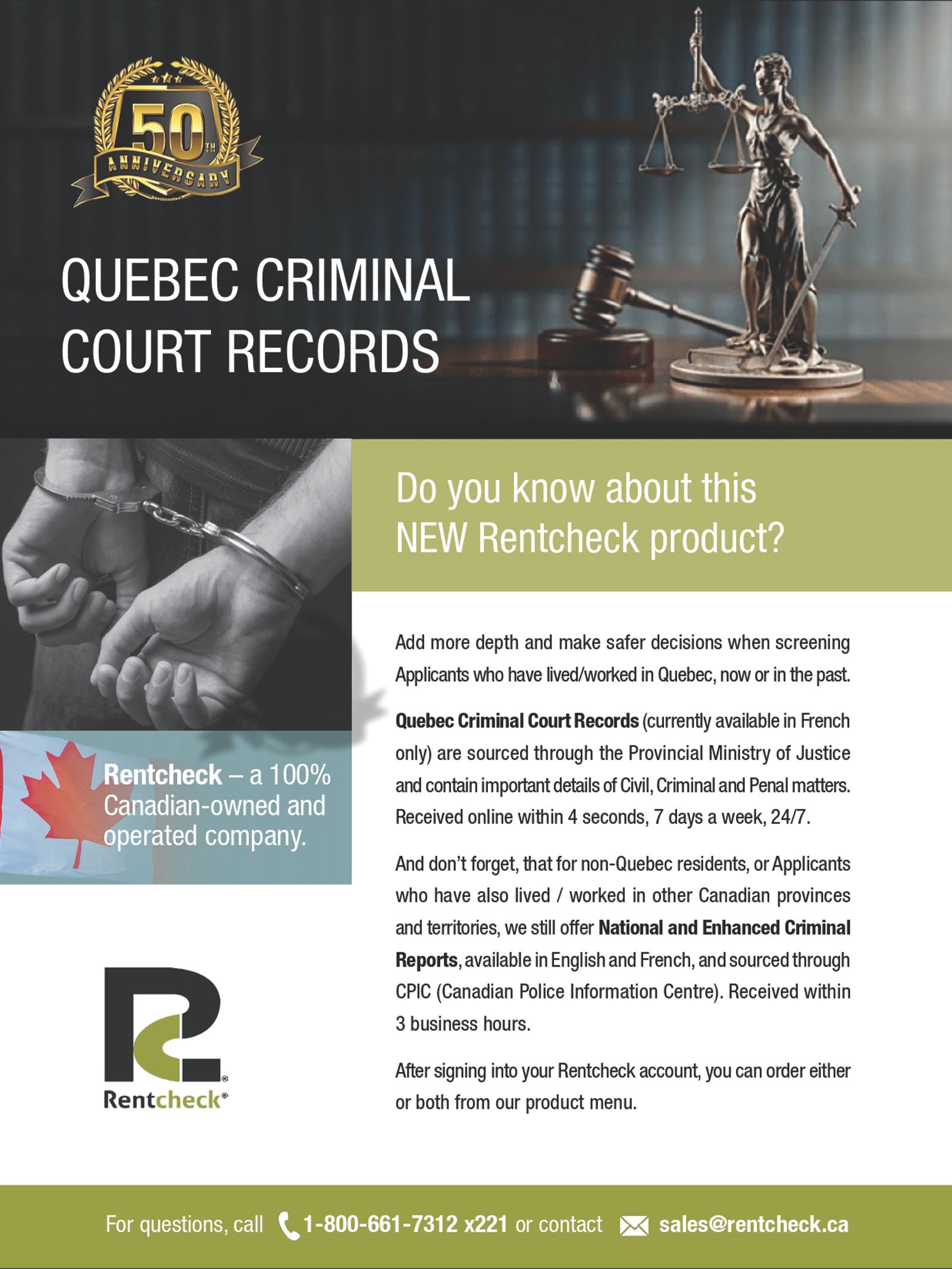
    Criminal Searches – A national Canadian criminal check can be ordered for a subject involved in credit or rental history screening check; individuals living or working in Quebec can have criminal records requested separately. A national US criminal, sex offender, OFAC, or Eviction record search for US housing applicants to Canada is also available.

    These tools assist Canadian housing providers and other screening professionals in identifying potential risks and confirming the accuracy of information submitted by applicants.

    Gold Star Tenants: Encouraging Responsible Renting

    Another innovative program launched by Rentcheck® is the Gold Star Tenants initiative.

    Under this system, residents earn recognition for maintaining a consistent payment record. A tenant receives a Gold Star after 12 months of on-time and in-full payments, with five (5) stars awarded for up to 60 consecutive months of good standing.

    Residents can earn up to 5 years of continuous Gold Star standing, indicating outstanding reliability. This system not only motivates tenants but also helps housing providers identify the most reliable and responsible rental applicants.

    Reducing Housing Discrimination

    The Rent Bureau of Canada® ’s data-driven approach also aims to reduce negative bias in housing decisions. Company research shows that 93 per cent of renters maintain good standing, contradicting the stereotype that those in lower-income or limited credit history brackets are less desirable tenants.

    By highlighting their positive rental histories, applicants are evaluated fairly and objectively. In fact, by December 2024, more than 26,000 applicants with credit scores below 500 were approved for housing because their RentScores demonstrated strong positive rental histories. Without rental history data, these individuals might have been rejected solely on the basis of their credit scores.

    Reducing Housing Discrimination

    Looking ahead, Rent Bureau of Canada® / Rentcheck® continues to expand its client reach and service capabilities.

    The company is now developing mobile platforms that will enable housing providers to manage applications and review tenant histories directly from smartphones and tablets. These innovations will further streamline the leasing process and enhance rapid access to housing information.

    New ways to better integrate rental history into financial systems are also being explored, allowing renters to use their payment records to build good credit and qualify for loans.

    A Legacy of Innovation

    Today, 50 years after its founding, Rent Bureau of Canada® / Rentcheck® remains a Canadian leader in state-of-the-art rental data analytics. What began with John M. Dobrowolski’s untiring efforts as one small landlord to solve an individual tenant issue has expanded into a nationwide platform supporting thousands of housing providers and millions of renters.

    Through innovations like rental history reporting, RentScore® analytics, and collaborative data exchange networks, Dobrowolski and the Rentcheck® team have redefined how rental housing decisions are made.

    Their work has shown that responsible tenants merit recognition and that fair housing choices depend on rapid, secure access to accurate, complete screening information.

    In an industry where trust and transparency are essential, Rent Bureau of Canada® / Rentcheck® continues to play a critical and innovative role in shaping the future of rental housing.


    — by John M.Dobrowolski

    Unified Magazine provides expert insights on business, technology, and innovation. We partner with leading entrepreneurs to provide strategic advice and market analysis, empowering professionals and entrepreneurs with resources for success and growth.

    Copyrights ©2026 Unified Magazine. All rights reserved