


Unified Magazine provides expert insights on business, technology, and innovation. We partner with leading entrepreneurs to provide strategic advice and market analysis, empowering professionals and entrepreneurs with resources for success and growth.
Subscribe to Updates
Get the latest creative news from FooBar about art, design and business.

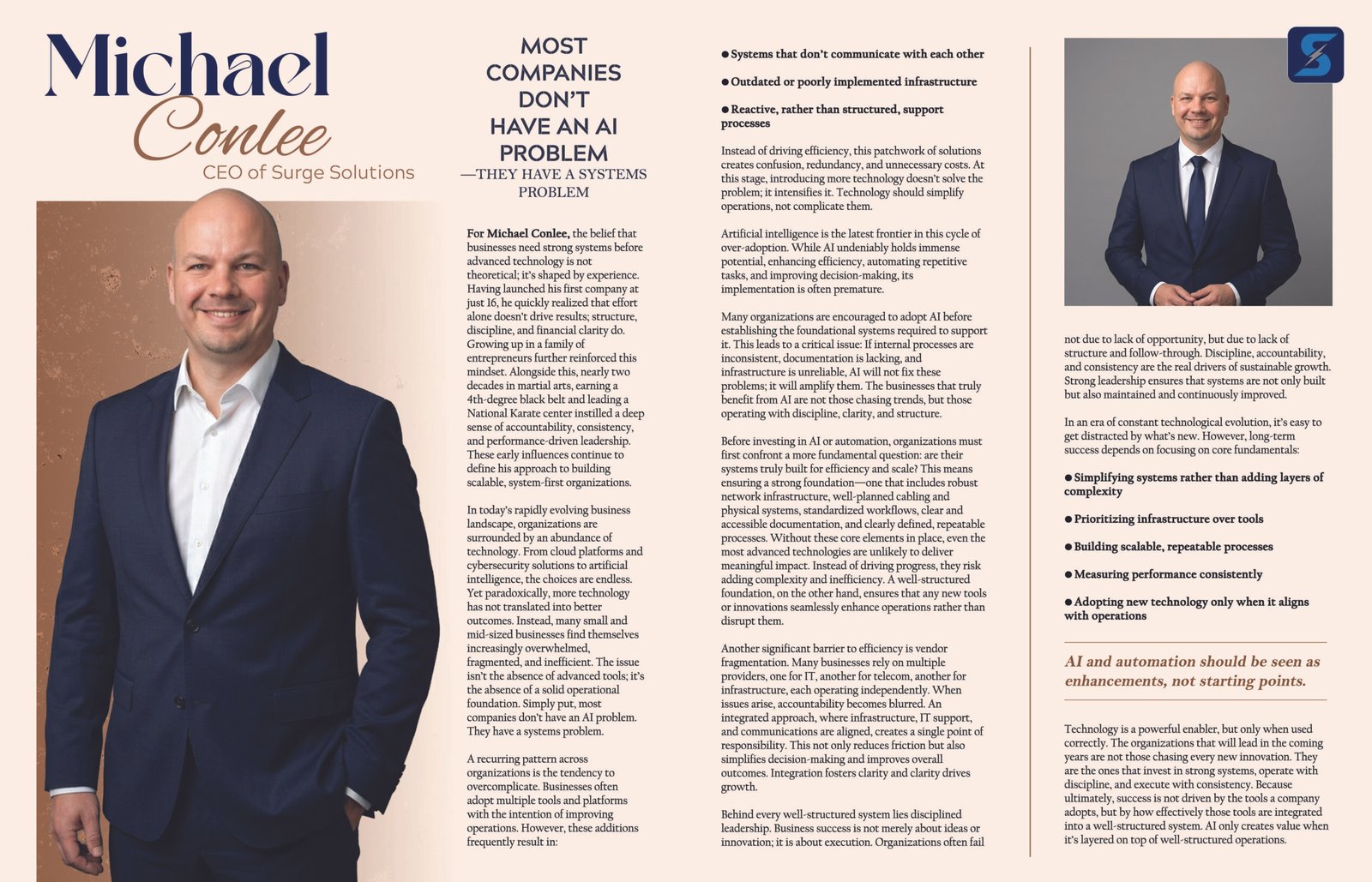
Michael Conlee: Technology Leader Helping Businesses Build Before They Scale
CEO of Surge Solutions
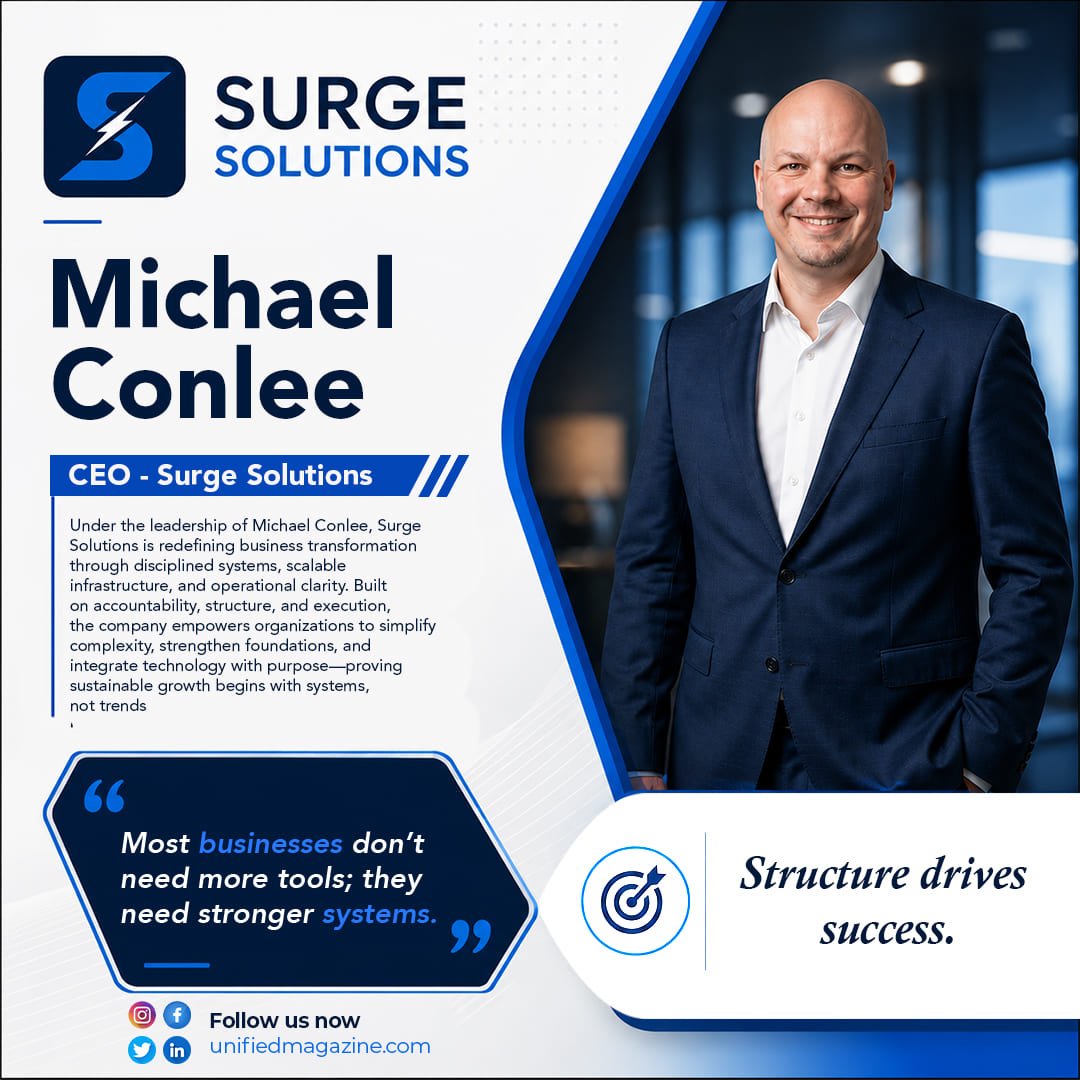
Surge Solutions helps businesses build scalable, system-first operations by strengthening infrastructure, simplifying technology, and aligning processes for long-term efficiency. Led by Michael Conlee, the company focuses on disciplined execution, operational clarity, and integrated solutions that prepare organizations for sustainable growth and effective AI adoption.
Michael Conlee's Exclusive
For Michael Conlee, the belief that businesses need strong systems before advanced technology is not theoretical; it’s shaped by experience. Having launched his first company at just 16, he quickly realized that effort alone doesn’t drive results; structure, discipline, and financial clarity do. Growing up in a family of entrepreneurs further reinforced this mindset. Alongside this, nearly two decades in martial arts, earning a 4th-degree black belt and leading a National Karate center instilled a deep sense of accountability, consistency, and performance-driven leadership. These early influences continue to define his approach to building scalable, system-first organizations.
In today’s rapidly evolving business landscape, organizations are surrounded by an abundance of technology. From cloud platforms and cybersecurity solutions to artificial intelligence, the choices are endless. Yet paradoxically, more technology has not translated into better outcomes. Instead, many small and mid-sized businesses find themselves increasingly overwhelmed, fragmented, and inefficient. The issue isn’t the absence of advanced tools; it’s the absence of a solid operational foundation. Simply put, most companies don’t have an AI problem. They have a systems problem.
A recurring pattern across organizations is the tendency to overcomplicate. Businesses often adopt multiple tools and platforms with the intention of improving operations. However, these additions frequently result in:
• Systems that don’t communicate with each other
• Outdated or poorly implemented infrastructure
• Reactive, rather than structured, support processes
Instead of driving efficiency, this patchwork of solutions creates confusion, redundancy, and unnecessary costs. At this stage, introducing more technology doesn’t solve the problem; it intensifies it. Technology should simplify operations, not complicate them.
Artificial intelligence is the latest frontier in this cycle of over-adoption. While AI undeniably holds immense potential, enhancing efficiency, automating repetitive tasks, and improving decision-making, its implementation is often premature.
Many organizations are encouraged to adopt AI before establishing the foundational systems required to support it. This leads to a critical issue: If internal processes are inconsistent, documentation is lacking, and infrastructure is unreliable, AI will not fix these problems; it will amplify them. The businesses that truly benefit from AI are not those chasing trends, but those operating with discipline, clarity, and structure.
Before investing in AI or automation, organizations must first confront a more fundamental question: are their systems truly built for efficiency and scale? This means ensuring a strong foundation—one that includes robust network infrastructure, well-planned cabling and physical systems, standardized workflows, clear and accessible documentation, and clearly defined, repeatable processes. Without these core elements in place, even the most advanced technologies are unlikely to deliver meaningful impact. Instead of driving progress, they risk adding complexity and inefficiency. A well-structured foundation, on the other hand, ensures that any new tools or innovations seamlessly enhance operations rather than disrupt them.
Another significant barrier to efficiency is vendor fragmentation. Many businesses rely on multiple providers, one for IT, another for telecom, another for infrastructure, each operating independently. When issues arise, accountability becomes blurred. An integrated approach, where infrastructure, IT support, and communications are aligned, creates a single point of responsibility. This not only reduces friction but also simplifies decision-making and improves overall outcomes. Integration fosters clarity and clarity drives growth.
Behind every well-structured system lies disciplined leadership. Business success is not merely about ideas or innovation; it is about execution. Organizations often fail not due to lack of opportunity, but due to lack of structure and follow-through. Discipline, accountability, and consistency are the real drivers of sustainable growth. Strong leadership ensures that systems are not only built but also maintained and continuously improved.
In an era of constant technological evolution, it’s easy to get distracted by what’s new. However, long-term success depends on focusing on core fundamentals:
• Simplifying systems rather than adding layers of complexity
• Prioritizing infrastructure over tools
• Building scalable, repeatable processes
• Measuring performance consistently
• Adopting new technology only when it aligns with operations
AI and automation should be seen as enhancements, not starting points.
Technology is a powerful enabler, but only when used correctly. The organizations that will lead in the coming years are not those chasing every new innovation. They are the ones that invest in strong systems, operate with discipline, and execute with consistency. Because ultimately, success is not driven by the tools a company adopts, but by how effectively those tools are integrated into a well-structured system. AI only creates value when it’s layered on top of well-structured operations.


Copyrights ©2026 Unified Magazine. All rights reserved