


Unified Magazine provides expert insights on business, technology, and innovation. We partner with leading entrepreneurs to provide strategic advice and market analysis, empowering professionals and entrepreneurs with resources for success and growth.
Subscribe to Updates
Get the latest creative news from FooBar about art, design and business.

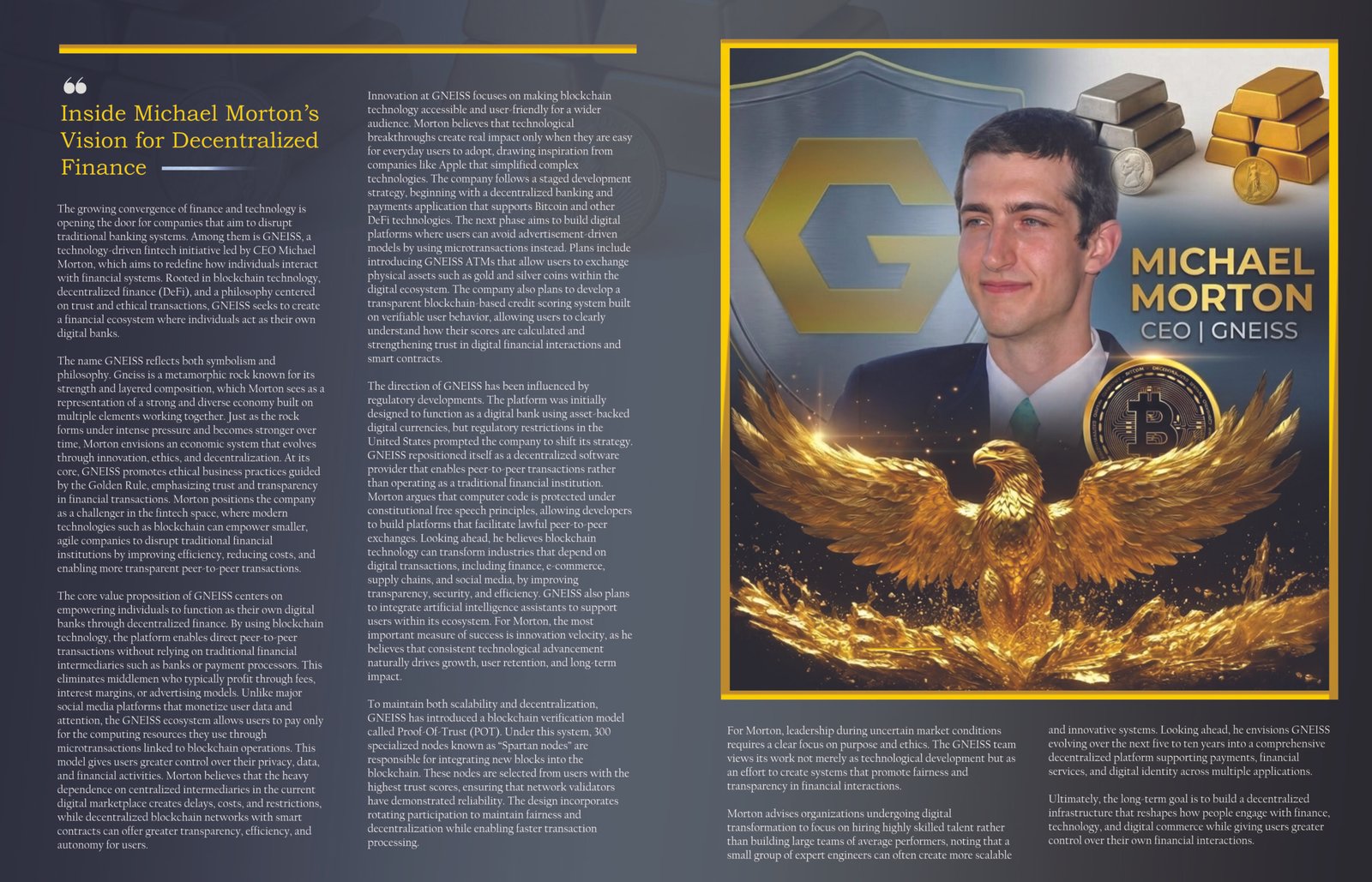
Michael Morton - Vision for Decentralized Finance
Chief Executive Officer of GNEISS
Michael Morton leads GNEISS with a vision rooted in ethics, decentralization, and the Golden Rule. He empowers individuals to become their own digital banks through blockchain and DeFi. His leadership focuses on innovation velocity, trust, and transparency. Inspired by metamorphic rock formed under pressure, Morton is building a resilient financial ecosystem that challenges traditional banking through purpose-driven technology.
Michael's Exclusive
The growing convergence of finance and technology is opening the door for companies that aim to disrupt traditional banking systems. Among them is GNEISS, a technology-driven FinTech initiative led by CEO Michael Morton, which aims to redefine how individuals interact with financial systems. Rooted in blockchain technology, decentralized finance (DeFi), and a philosophy centered on trust and ethical transactions, GNEISS seeks to create a financial ecosystem where individuals act as their own digital banks.
The name GNEISS reflects both symbolism and philosophy. Gneiss is a metamorphic rock known for its strength and layered composition, which Morton sees as a representation of a strong and diverse economy built on multiple elements working together. Just as the rock forms under intense pressure and becomes stronger over time, Morton envisions an economic system that evolves through innovation, ethics, and decentralization. At its core, GNEISS promotes ethical business practices guided by the Golden Rule, emphasizing trust and transparency in financial transactions. Morton positions the company as a challenger in the FinTech space, where modern technologies such as blockchain can empower smaller, agile companies to disrupt traditional financial institutions by improving efficiency, reducing costs, and enabling more transparent peer-to-peer transactions.
The core value proposition of GNEISS centers on empowering individuals to function as their own digital banks through decentralized finance. By using blockchain technology, the platform enables direct peer-to-peer transactions without relying on traditional financial intermediaries such as banks or payment processors. This eliminates middlemen who typically profit through fees, interest margins, or advertising models. Unlike major social media platforms that monetize user data and attention, the GNEISS ecosystem allows users to pay only for the computing resources they use through microtransactions linked to blockchain operations. This model gives users greater control over their privacy, data, and financial activities. Morton believes that the heavy dependence on centralized intermediaries in the current digital marketplace creates delays, costs, and restrictions, while decentralized blockchain networks with smart contracts can offer greater transparency, efficiency, and autonomy for users.
Innovation at GNEISS focuses on making blockchain technology accessible and user-friendly for a wider audience. Morton believes that technological breakthroughs create real impact only when they are easy for everyday users to adopt, drawing inspiration from companies like Apple that simplified complex technologies. The company follows a staged development strategy, beginning with a decentralized banking and payments application that supports Bitcoin and other DeFi technologies. The next phase aims to build digital platforms where users can avoid advertisement-driven models by using microtransactions instead. Plans include introducing GNEISS ATMs that allow users to exchange physical assets such as gold and silver coins within the digital ecosystem. The company also plans to develop a transparent blockchain-based credit scoring system built on verifiable user behavior, allowing users to clearly understand how their scores are calculated and strengthening trust in digital financial interactions and smart contracts.
The direction of GNEISS has been influenced by regulatory developments. The platform was initially designed to function as a digital bank using asset-backed digital currencies, but regulatory restrictions in the United States prompted the company to shift its strategy. GNEISS repositioned itself as a decentralized software provider that enables peer-to-peer transactions rather than operating as a traditional financial institution. Morton argues that computer code is protected under constitutional free speech principles, allowing developers to build platforms that facilitate lawful peer-to-peer exchanges. Looking ahead, he believes blockchain technology can transform industries that depend on digital transactions, including finance, e-commerce, supply chains, and social media, by improving transparency, security, and efficiency. GNEISS also plans to integrate artificial intelligence assistants to support users within its ecosystem. For Morton, the most important measure of success is innovation velocity, as he believes that consistent technological advancement naturally drives growth, user retention, and long-term impact.
To maintain both scalability and decentralization, GNEISS has introduced a blockchain verification model called Proof-Of-Trust (POT). Under this system, 300 specialized nodes known as “Spartan nodes” are responsible for integrating new blocks into the blockchain. These nodes are selected from users with the highest trust scores, ensuring that network validators have demonstrated reliability. The design incorporates rotating participation to maintain fairness and decentralization while enabling faster transaction processing.
For Morton, leadership during uncertain market conditions requires a clear focus on purpose and ethics. The GNEISS team views its work not merely as technological development but as an effort to create systems that promote fairness and transparency in financial interactions.
Morton advises organizations undergoing digital transformation to focus on hiring highly skilled talent rather than building large teams of average performers, noting that a small group of expert engineers can often create more scalable and innovative systems. Looking ahead, he envisions GNEISS evolving over the next five to ten years into a comprehensive decentralized platform supporting payments, financial services, and digital identity across multiple applications. Ultimately, the long-term goal is to build a decentralized infrastructure that reshapes how people engage with finance, technology, and digital commerce while giving users greater control over their own financial interactions.



Copyrights ©2026 Unified Magazine. All rights reserved